
In the evolving landscape of oral care, the transition from traditional spool floss to the dental floss pick has been a defining trend of the last decade. For retailers, distributors, and pharmacy chains, dental floss sticks are no longer just a convenience item; they are a staple category driver. However, to effectively market and sell these products, B2B buyers must understand the engineering behind them. While they appear simple, quality floss picks are precision-engineered tools designed to perform a complex mechanical task: disrupting biofilm in tight interdental spaces. This guide explores the functional mechanics of dental floss sticks, the material science behind the thread, and why partnering with a professional dental floss manufacturer like Sugere (Guangdong Sugere Daily Chemicals Co., Ltd.) is essential for product efficacy.
The Structural Anatomy of a Floss Stick
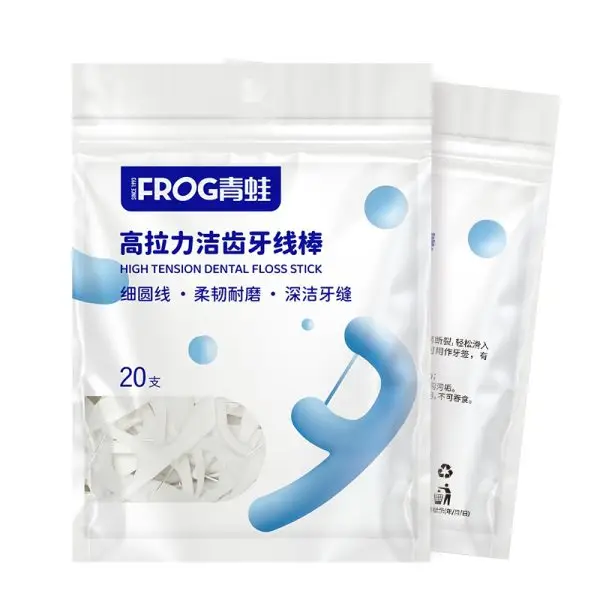
To understand how dental floss sticks work, one must first deconstruct their anatomy. Unlike a long piece of string wrapped around fingers, a floss stick is a pre-tensioned system. It consists of three primary components, each serving a distinct biomechanical function:
- The Bow (The Head): This is the U-shaped or F-shaped arch that holds the fiber. Its primary job is to maintain high tensile strength. If the bow deforms under pressure, the floss becomes loose and ineffective.
- The Fiber (The Floss): The active cleaning element. In modern manufacturing, this is rarely just cotton or simple nylon.
- The Handle and Tail: The handle provides leverage (the fulcrum), while the tail often tapers into a sharpened pick, serving a dual function as a toothpick for removing larger food debris.
For a specialized dental floss manufacturer, the challenge lies in balancing the rigidity of the handle with the flexibility required to navigate the mouth safely.
The Science of the Fiber: UHMWPE vs. PTFE
The core mechanism of flossing is “shearing force.” The fiber must slide between tight contact points of teeth without snapping and then scrape the tooth surface. How well a stick performs this depends entirely on the material. Top-tier manufacturers like Sugere primarily utilize UHMWPE (Ultra-High Molecular Weight Polyethylene) fiber. From a popular science perspective, UHMWPE is fascinating because it has one of the highest strength-to-weight ratios of any fiber—stronger than steel on a weight-for-weight basis.
- How it works: Because UHMWPE is naturally slick (low coefficient of friction) and incredibly strong, it slips easily between tight teeth without shredding. Unlike traditional nylon which might fray, high-grade UHMWPE remains intact, ensuring the user can complete the entire mouth with a single pick.
- PTFE (Polytetrafluoroethylene): Another common material is PTFE (often known by the brand Teflon). This is a flat, ribbon-like fiber. It works by sliding effortlessly through the tightest contacts.
When sourcing dental floss sticks, specifying the fiber type is crucial. Sugere offers customization options (OEM/ODM) allowing brands to choose between high-strength polymer fibers or expanding floss depending on the target market needs.
The Mechanism of Action: Tension and Leverage
The genius of the dental floss sticks design lies in the pre-set tension. With traditional floss, the user must manually create tension by wrapping string around their fingers—a technique many consumers fail to master.
- The “Bow” Mechanism:The plastic bow holds the short segment of floss under permanent tension. When the user inserts the floss between teeth, the bow acts as a spring. It resists the compression force of the contact point. Once the floss passes the contact point and enters the gingival sulcus (the gum line), the tension allows the user to apply lateral pressure against the tooth surface. This lateral pressure is vital. To clean effectively, the floss must “hug” the tooth in a C-shape. The rigid handle of the floss stick allows the user to manipulate the angle of the head, forcing the thread against the side of the tooth to scrape away the biofilm (plaque) vertically, away from the gum.
- The Leverage Advantage:The handle acts as a lever arm. This allows the user to reach back molars—areas that are notoriously difficult to clean with string floss—without putting their hands inside their mouth. For consumers with limited dexterity (such as the elderly or children), this leverage makes the difference between cleaning and not cleaning.
Material Safety and Manufacturing Integrity
Since these tools are used vigorously inside the mouth, the safety of the materials is non-negotiable. A responsible dental floss manufacturer must ensure that both the plastic handle and the fiber are food-grade and non-toxic. Sugere manufactures their handles using High-Impact Polystyrene (HIPS) or Food-Grade PP (Polypropylene).
- HIPS: This material is chosen for its rigidity. It ensures the “bow” doesn’t collapse when the user bites down or presses hard.
- Safety Compliance: As a company with over 30 years of experience and certifications including ISO 9001, GMP, BRC, and FDA registration, Sugere ensures that no harmful chemicals (like BPA) leach from the plastic during use.
Furthermore, the manufacturing process involves high-precision injection molding. If the mold is not perfect, the plastic handle can have “flash” (tiny, sharp excess plastic bits). Sugere’s advanced production lines ensure smooth, polished edges to prevent oral injury.
The Dual Function: The Tail Pick
The tail of the dental floss sticks is not an afterthought; it is an engineered tool. It typically features a curved, tapered tip designed to mimic a dental probe.
- How it works: While the floss removes microscopic biofilm, the pick is designed for macroscopic debris (food stuck between teeth).
- Engineering: The tip must be sharp enough to fit into interdental triangles but blunt enough not to pierce the gums. Sugere designs their handles with textured grips near the tail to give the user precise control during this picking action, preventing slips that could cause gum injury.
Why Manufacturing Quality Matters for B2B Buyers
For the end consumer, a floss stick just needs to work. But for the B2B buyer, the “how” is about consistency. In low-quality manufacturing, the tension of the thread varies. If the thread is too loose, it cannot snap past the contact point. If the anchoring of the thread into the plastic is weak, it pulls out mid-use. Partnering with a proven dental floss manufacturer like Sugere eliminates these variables. Their automated assembly process ensures consistent tension and secure anchoring of the fiber into the handle. With a factory capacity tailored for global export (providing OBM, OEM, and ODM services), we deliver a product that performs reliably, batch after batch.
Conclusion
Dental floss sticks are a triumph of micro-engineering. They combine high-tech fibers like UHMWPE with structurally optimized plastic handles to make oral hygiene accessible and effective. They work by maintaining the necessary tension to shear off plaque while providing the mechanical leverage to reach the deepest parts of the mouth. For distributors and brand owners, understanding these mechanics is key to selecting the right product. By sourcing from Sugere, a veteran dental floss manufacturer, you ensure that your product features the optimal balance of fiber strength, handle safety, and ergonomic design. In a market where quality defines brand loyalty, offering a superior floss stick is the smartest way to secure your place in the consumer’s daily routine.