
In the global oral care market, the children’s segment is governed by a unique set of rules. Unlike adult products, where aesthetics often drive impulse buys, the children’s sector is dominated by parental concern for safety, efficacy, and ease of use. For B2B buyers—whether distributors, pharmacy chains, or private label brands—sourcing the right product is critical. It is not enough to simply find a product that looks appealing; the engineering behind the children toothbrush must be scientifically sound. When planning to source bulk kids toothbrushes, procurement officers must evaluate two fundamental components: the bristle technology and the handle ergonomics. This guide dives into the technical criteria for selecting the best products and highlights how manufacturers like Sugere (Guangdong Sugere Daily Chemicals Co., Ltd.) are setting the standard for safety and design.
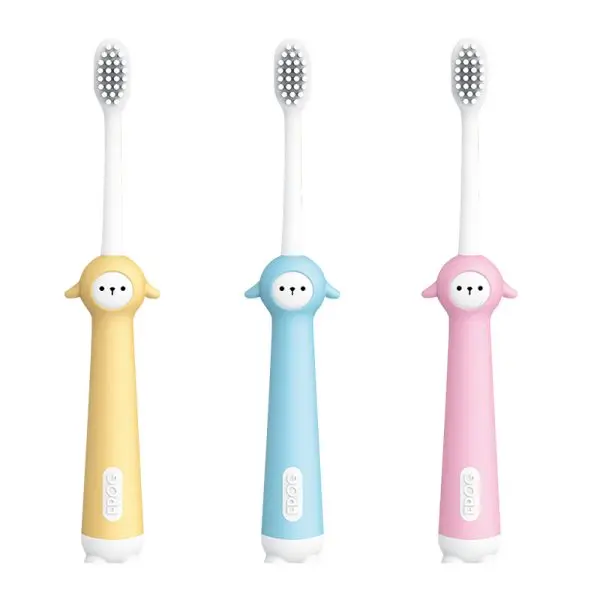
The Science of Bristles: Material and Geometry
The bristle is the operational center of any toothbrush. For children, whose enamel is thinner and gums are more sensitive than adults, the margin for error is non-existent. When selecting a manufacturer for your bulk kids toothbrushes, you must look beyond generic nylon.
- Material Matters: PBT vs. Nylon
While traditional brushes often use standard nylon, modern high-quality manufacturing has shifted toward PBT (Polybutylene Terephthalate). PBT offers superior durability and, crucially, absorbs less water than nylon. This limits bacterial growth in the damp environment of a bathroom—a key selling point for hygiene-conscious parents. Sugere utilizes high-grade PBT filaments in their children’s lines. This material choice ensures that the bristles maintain their resilience (stiffness) longer, providing an effective clean without becoming splayed and abrasive too quickly.
- The Micron Standard: ≤0.01mm Tips
The most critical specification to look for is the tip diameter. Standard cutting leaves bristles with blunt ends that can scratch soft tissue. Top-tier manufacturers like Sugere employ advanced chemical tapering technology to sharpen bristle tips to a diameter of ≤0.01mm. From a popular science perspective, this is vital for the “interdental” and “gingival” cleaning. These ultra-fine tips can slip gently into the sulcus (the pocket between the gum and tooth) and tight gaps between teeth where cavities often start. For a children toothbrush, this provides a deep clean that doesn’t rely on the child applying heavy pressure, which they often lack the motor skills to do properly.
Handle Ergonomics: Sizing and Material Safety
The handle of a children toothbrush is not just a holder; it is a tool that must bridge the gap between a child’s developing dexterity and the need for precision. When browsing catalogs for bulk kids toothbrushes, the handle specifications should be scrutinized as closely as the bristles.
- The Grip Factor: Material Engineering
Children, especially toddlers, lack the fine motor control to hold a thin handle using a “precision grip” (fingertips). They typically use a “power grip” (full fist). Therefore, a suitable handle must be voluminous and non-slip. Sugere addresses this by using composite materials, typically combining a rigid Food-Grade PP (Polypropylene) core with a soft TPE (Thermoplastic Elastomer) or Silica Gel overmold. This combination offers structural integrity with a soft, tactile surface that prevents the brush from slipping out of a wet hand. The use of food-grade materials is non-negotiable, as young children often chew on the brush head or handle.
- Head-to-Handle Ratio
A common mistake in generic manufacturing is pairing a small head with an adult-sized handle, or vice versa. A professional children toothbrush must feature a compact head—sized to cover only 2 to 3 teeth at a time—to allow for maneuverability in a small mouth. However, the handle length and girth must correspond to the target age group’s hand size. Sugere’s product lines are segmented by developmental stages, offering specific dimensions for toddlers (0-3 years) and juniors (3+ years). This attention to anthropometric data ensures that the product is actually usable by the end consumer, leading to higher brand loyalty and repeat purchases.
Safety Standards and Manufacturing Integrity
For B2B buyers, the physical specs are only half the battle. The manufacturing process determines the safety and reliability of the stock. When you order bulk kids toothbrushes, you become liable for the safety of those products in your local market.
- Bristle Retention Force
One of the biggest choking hazards associated with low-quality brushes is bristle shedding. Professional manufacturers use advanced flocking or fusing technologies to anchor bristles securely. Sugere, with over 30 years of industry experience, employs automated high-speed tufting machines that ensure high retention force, exceeding international safety standards.
- Certification as a Trust Signal
Your sourcing strategy should prioritize factories with verified quality management systems. Sugere operates under ISO 9001, GMP (Good Manufacturing Practice), BRC, and BSCI certifications. These are not just badges; they are guarantees that the children toothbrush products leaving the factory have been produced in a clean, controlled environment, free from cross-contamination.
The Strategic Advantage of OEM/ODM
Understanding specs allows you to buy better, but understanding the manufacturer’s capabilities allows you to sell better. Sugere is not just a supplier; they are a strategic partner for OBM, OEM, and ODM services. If your market research indicates a demand for a specific handle shape—perhaps a character design to encourage brushing—Sugere’s R&D team can develop custom molds. If your market demands specific color coding for different age groups, their vast production capacity (over 200 million pieces annually) can accommodate these variations seamlessly. By leveraging their expertise, you can customize the specs discussed above. You might request a specific bristle softness (e.g., Extra Soft vs. Soft) or a particular handle material blend to suit your brand’s price point and positioning.
Conclusion
Selecting the right oral care products for children is a balance of engineering, safety, and ergonomics. It requires looking at the children toothbrush not as a commodity, but as a medical device designed for a vulnerable user base. For procurement officers and brand managers, the checklist is clear: Look for PBT bristles with ≤0.01mm tapered tips for gentle efficacy. Insist on food-grade PP and TPE handles designed for the specific motor skills of the target age. And most importantly, partner with a manufacturer that guarantees consistency. Sourcing bulk kids toothbrushes from a reputed industry leader like Sugere ensures that every specification—from the bristle tip to the handle grip—is optimized for health and safety. In a market where trust is the ultimate currency, delivering a product that is scientifically designed and safely manufactured is the surest path to business growth.