
Yes, you can bring toothpaste on a plane, but it is strictly regulated as a gel. Under the standard TSA security protocols, any toothpaste packed in a carry-on bag must be in a container that is 3.4 ounces (100 milliliters) or smaller.
Crucially, airport security enforces this limit based on the printed volume on the tube, not the amount of paste remaining inside. When determining exactly what size manual toothbrush and toothpaste you can bring on a plane, remember that any tube exceeding 3.4 ounces must go into your checked luggage, regardless of how flat or empty it appears.
Still have questions or under some special conditions? Keep rolling. This blog details every toothpaste luggage rule, even with a tool to help you decide the to bring or not to bring question.
What Is the 3-1-1 Rule for Oral Care?
If you are wondering what the TSA guidelines for liquids are, the baseline is the 3-1-1 rule. This limits all gels, pastes, and liquids to 3.4 ounces (100ml) or less, requires them to fit into one clear quart-sized bag, and restricts each passenger to one bag.
3.4 oz (100ml) Limit
Many travelers wonder why a thick paste is regulated like water. Aviation security classifies toothpaste as a “gel or paste” because it smears and cannot hold its physical shape outside of a container. Therefore, it is strictly subject to the TSA liquid limits. To fly with it in the cabin, the printed label must display 3.4 oz (100ml) or less.
Wondering what does 3.4oz look like?
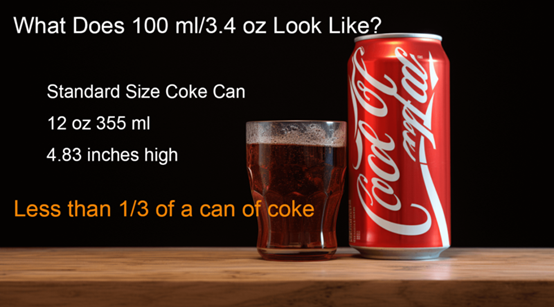
Source: AFSHAN PACKAGING: What Does 100 Ml/3.4oz Look Like? Travel Toiletries Size Guide
The 1-Quart Bag Constraint
Your travel size toothpaste cannot just be thrown loosely into a backpack. It must be placed inside a single, transparent, quart-sized resealable bag. This forces toothpaste to share valuable spatial real estate with your other liquids, such as shampoo, hand sanitizer, and lotion.
The 1-Bag Limit
Security protocols restrict each traveler to exactly one clear liquids bag. For consumers, this requires packing efficiency. For oral care brands, this highlights why manufacturing compact, space-saving tube profiles is critical for travel-friendly product lines.
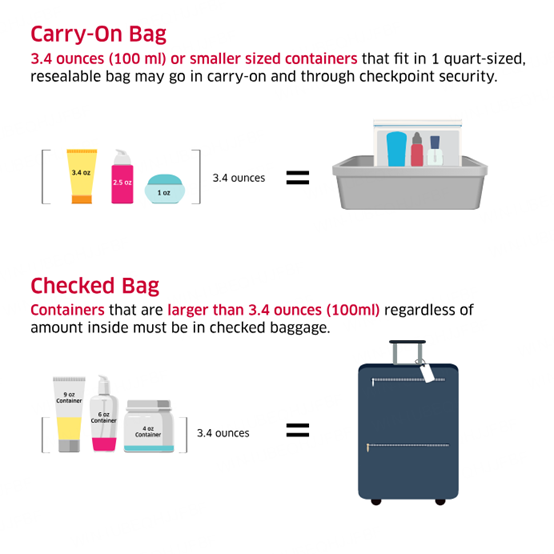
Source: TSA: Liquids, Aerosols, and Gels Rule
Are There Any “Grey Area” for My Package?
Travelers frequently encounter confusion regarding partially empty tubes, prescription oral care, and alternative formats. Security protocols are rigid regarding container sizing, but established exceptions exist for medically necessary pastes and solid tablet formats.
- ⚠️ The “Half-Empty” Rule: A very common question on travel forums is, “Can I bring a 5 oz tube if it is mostly empty?” The objective answer is no. TSA agents do not measure the remaining carry-on liquid ounces inside a tube. They look exclusively at the maximum capacity printed on the packaging. A nearly empty 5 oz tube will be confiscated.
- 💊 Prescription Toothpaste: There is a “Medically Necessary” exception. If you are flying with toothpaste that is a high-fluoride prescription or a medically mandated treatment, it can often bypass the 3.4 oz limit. However, you must declare it to a TSA officer before screening, and it will be subject to additional testing.
- ✨ Solid Toothpaste (Tabs): Toothpaste tablets provide a highly effective, liquid-free loophole. Because they are completely solid and lack water content, they are not subject to the 3-1-1 rule. They can be packed in any quantity without taking up space in a passenger’s liquid bag.
International Variations and 2026 Scanner Updates
While most global airports adhere strictly to the 100ml standard, newly installed C3 CT scanners in several UK and EU airports in 2026 allow up to 2-liter liquids in carry-ons. However, due to inconsistent global rollouts, the 100ml tube remains the undisputed manufacturing standard.
EU/UK Scanner Updates
As of early 2026, major transit hubs like London Heathrow, Birmingham, and Edinburgh have deployed advanced C3 CT scanners. These machines create 3D internal images, allowing these specific airports to scrap the 100ml rule and allow larger liquids through security.
However, this rollout is not universal. A passenger might fly out of Heathrow with a 6 oz tube, only to have it confiscated on their connecting flight in a different country that still relies on older X-ray technology. For consistency, authorities advise travelers to stick to the 100ml limit globally.
Toothpaste Travel Checker
Find out if your toothpaste meets 2026 TSA & International LAGs rules.
So, What Does it Mean for Oral Care Brand?
For retail buyers and distributors, this fragmented security landscape dictates packaging strategy. Professional B2B manufacturers like Sugere offer customized service that allows 100ml, 75ml, or 50ml packaging for standard and travel lines.
Procuring inventory strictly at or below the 100ml threshold ensures your product achieves global “travel-ready” compliance, eliminating friction for the end consumer regardless of where they fly.
→ [2026] Sugere Oral Care Products Overview
Packing and Procuring for the Skies
Strict compliance with the 3.4 oz (100ml) limit ensures seamless travel through global airport security. Both consumers and retail brands must prioritize appropriately sized, clearly labeled packaging to avoid confiscation.
For consumers, always check the printed volume on your tube. For procurement teams, partnering with a manufacturer that understands strict global packaging requirements is essential.
If your brand requires precision-manufactured, travel-compliant oral care products, contact Sugere today to explore our OEM packaging and formulation capabilities.